Reframing the Rosary as a Pagan Practice
The word “rosary” evokes a familiar and iconic image of beads cascading from someone’s hand as they grasp the crucifix pendant in prayerful meditation. As a new catholic in my early twenties, the rosary was a comfort and a direct line to the ear of the holy mother Mary. This devotion to her was my anchor as I was tossed violently by the roughest seas of my life. I held tightly to her, and she didn’t fail me.
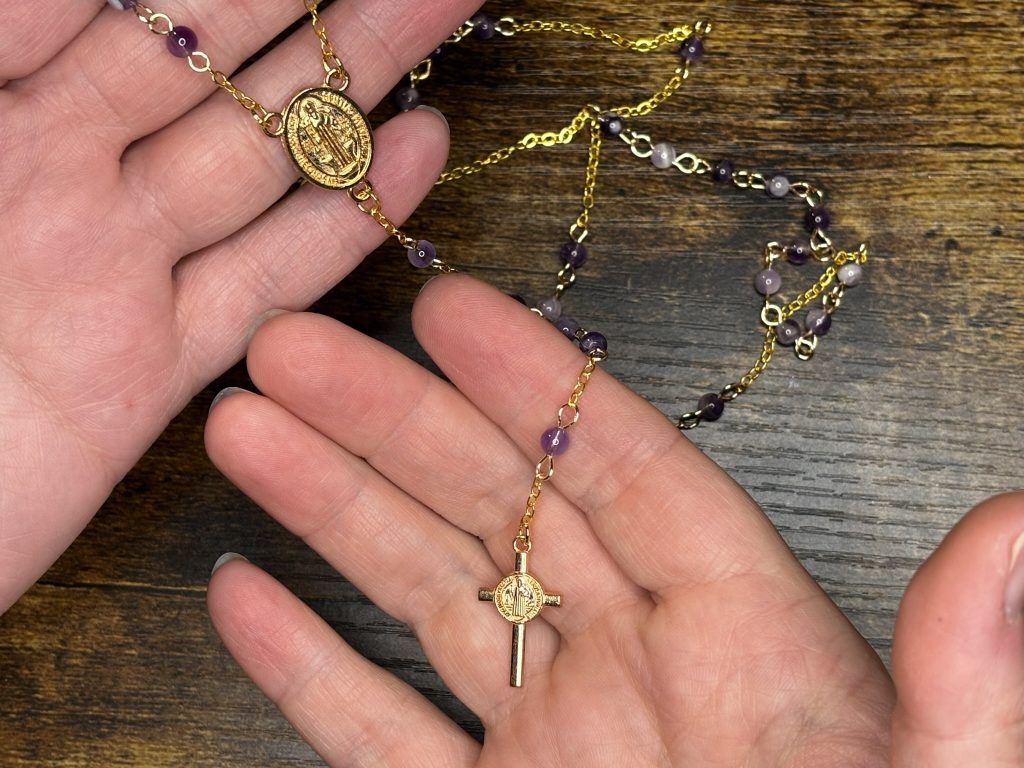
Years later, I found myself walking away from the church and from the umbrella of the Christian faith altogether. I hadn’t lost my faith in Jesus or in Mary, but I had lost all hope for the human institution of religion. I saw coercive patterns in its doctrine, and harmful prejudices in its culture. I left to protect my own children from being subject to the systems that had victimized and traumatized me in my formative years.
Still, I clung to the rosary for my very life.
When I found the pagan path, connecting to archetypes of the god and goddess apparent in the seasons of the earth and cosmos, I yearned for that tangible and tactile communion with the divine. I started to envision beads in sets of a specific number to honor a deity’s aspects, with a pendant of a key for Hecate, the mother of witches. I learned how rosaries are constructed, which tools are used, and found the materials I needed to bring this vision into reality.
My first pagan rosary to Hecate was born in the fall of 2024.
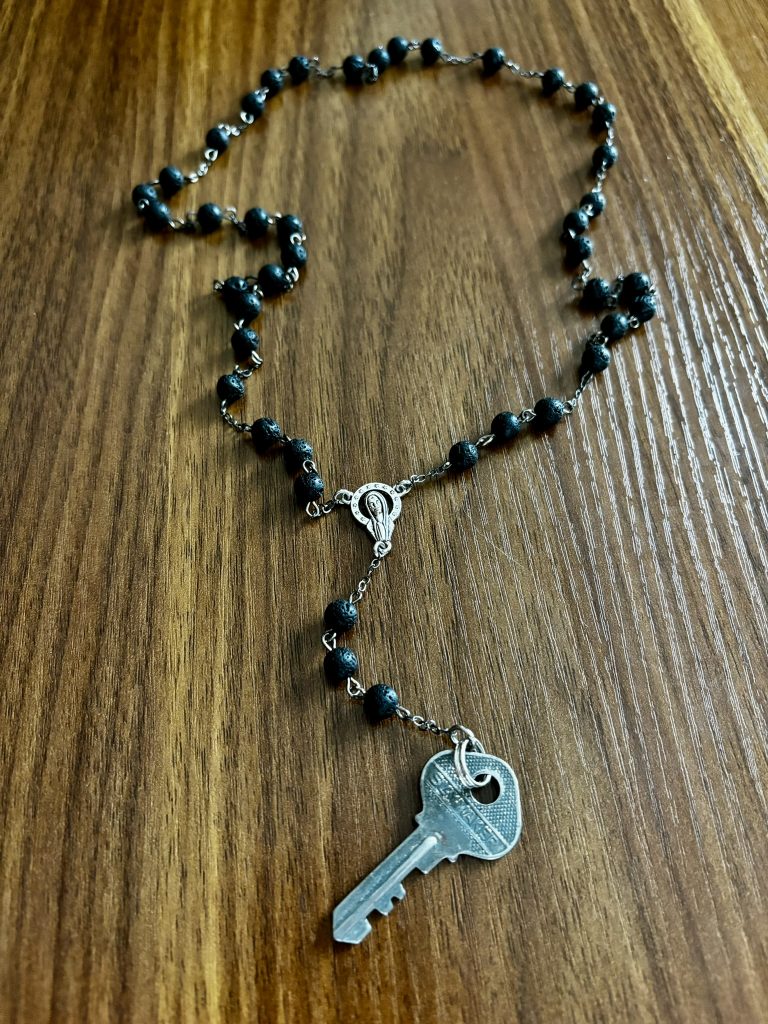
Since then, a number of people have asked me why I can so brazenly call this a rosary, since it is not in fact a devotion to mother Mary. Isn’t the term “pagan rosary” an oxymoron?
I am well aware this practice will be considered sacrilegious to some, but I am also aware many Christians believe praying the catholic rosary – or even owning one – is demonic. No matter what you do, someone will have a strong opposing opinion. I will not defend my pagan rosary practice, since we are each entitled to our own beliefs. I will simply explain my choice in borrowing this word.
Prayer beads have long played a major role in religious rituals, with records of their use dating back to the 17th century BCE in connection to the Hindu faith. They have crossed multiple religious groups, and have varied greatly in appearance, materials, and function. The catholic rosary has roots in early Christianity, with prayer beads appearing among Christian monks in Egypt around the 3rd century CE. However, the earliest record of prayer beads being called a Rosary is not found until the early 1500s CE.
I recently found a presentation that was published in 1918 by Winifred S. Blackman in a collection of works titled Folklore: Transactions of the Folklore Society. In this, Blackman presents the history of prayer beads and the rich diversity of practice across cultures and religions. Throughout this publication, she refers to prayer beads in general as “rosaries.” I cannot be certain, but I wonder if this was an intentional choice rather than a malapropism.
I chose to call my pieces “rosaries” because of the image that word immediately conjures. Pagan prayer beads have always existed parallel to their local religious influences. Since I design these around the style and construction of a traditional catholic rosary, I want to draw a connection to that image when I’m introducing the concept to someone.
Blackman describes in detail the unique rituals involving prayer beads and how they differ between religious sects. It is an interesting read, and I highly recommend it for anyone who is looking for historical precedent to help shape their own practices. You can find a free version of The Rosary in Magic and Religion here.
The function of a pagan rosary will differ from practice to practice. Every person will connect in a unique way with their deity, intention or affirmation. For this reason, the elements and arrangements are also unique to the user. While I do have some rosaries ready to sell, the bulk of my orders are wonderfully custom creations. This speaks directly to the richness of diversity in our global pagan communities.
While a pagan rosary may be prayed as a catholic rosary would, the uses do not end there. Many pagans do not even pray to a deity. A rosary may function as a sensory meditation aid, as a reminder of personal affirmations, or as an amulet for protection. A person may choose to reserve their rosary for ceremonial rites, or they may wear it daily and connect with it more personally.
When I wear my rosary to Hecate, it’s like a portal to a virtual moonlit crossroads that I can access at any time. All I need do is close my eyes, touch the key, and she is with me. Wherever I am, if I am overwhelmed, off balance, or utterly lost, I can pass a set of beads through my fingers and whisper a prayer. All the world falls away in that sacred moment. My mind is unburdened, my lungs fill with air, and I exhale all the chaos. When I open my eyes, the path forward is clearer.
I do also make catholic rosaries, as this is still a vital part of my own spiritual practice and the holy mother is still very dear to me. I have the utmost respect for faithful Catholics, and I would never intentionally mishandle such a sacred item. If you are looking for a custom catholic rosary to honor Mary, I am happy to discuss the design with you and create something that aligns with your vision.
If you are new to prayer beads in general, and looking for guidance, I have posted several videos on my YouTube channel addressing this. We start at the very beginning with designing a rosary to fit your practice, then discuss how to create your own prayers and rituals, and how to integrate this into your spiritual life as a whole.
Wherever you find yourself on this journey, may you be met by the divine and recognize it in every form it takes.
Leave a Reply